

4 Top Healthcare Marketers Weigh In On Their Strategies For 2026
Editors' Note: We all need far more tactical information on how to grow and compete. So for our premium subscribers, Second Opinion will be convening the smartest and most thoughtful operators across the healthcare industry to dive into how they're spending budgets, finding new channels for growth, selling customers, raising capital, hiring and more. We are committed not just to ask the question of "why" but also "how." If you have ideas for an upcoming webinar that would be mission critical information for your business, or you'd like to be featured, fill out this form here.
In this week’s episode of Lifers, Chrissy hosts Dr. Kameron Matthews (Chief Health Officer at IMPaCT Care, Founding Physician at Roon, and a 13-year veteran of mentoring the next generation) & Shelli Pavone (President and Co-founder of Inlightened, on a mission to get clinicians onto cap tables and connect healthcare innovators with qualified expertise).
The latest episode of Lifers is available now! Watch on YouTube or listen wherever you get your podcastsThe latest episode of Lifers is available now! Watch on YouTube or listen wherever you get your podcasts
This episode refuses the usual healthcare optimism. Instead they cover:
- Why healthcare's "toxic positivity" (h/t Sachin Jain) prevents honest conversations about systemic failures
- The absurd reality of state licensing barriers: why your psychiatrist can't treat you across state lines (even by phone)
- What motivates the next generation to enter healthcare despite unprecedented burnout (and why Kameron still mentors students daily)
- Why clinicians need to become public communicators to combat health misinformation
- The AI vs. human debate in primary care - and why GLP-1s will have more impact than AI in the next decade
Thanks to Inlightened who facilitated this conversation. Healthcare professionals and “Lifers” can sign up to provide — and access — expert insights at https://getinlightened.com/
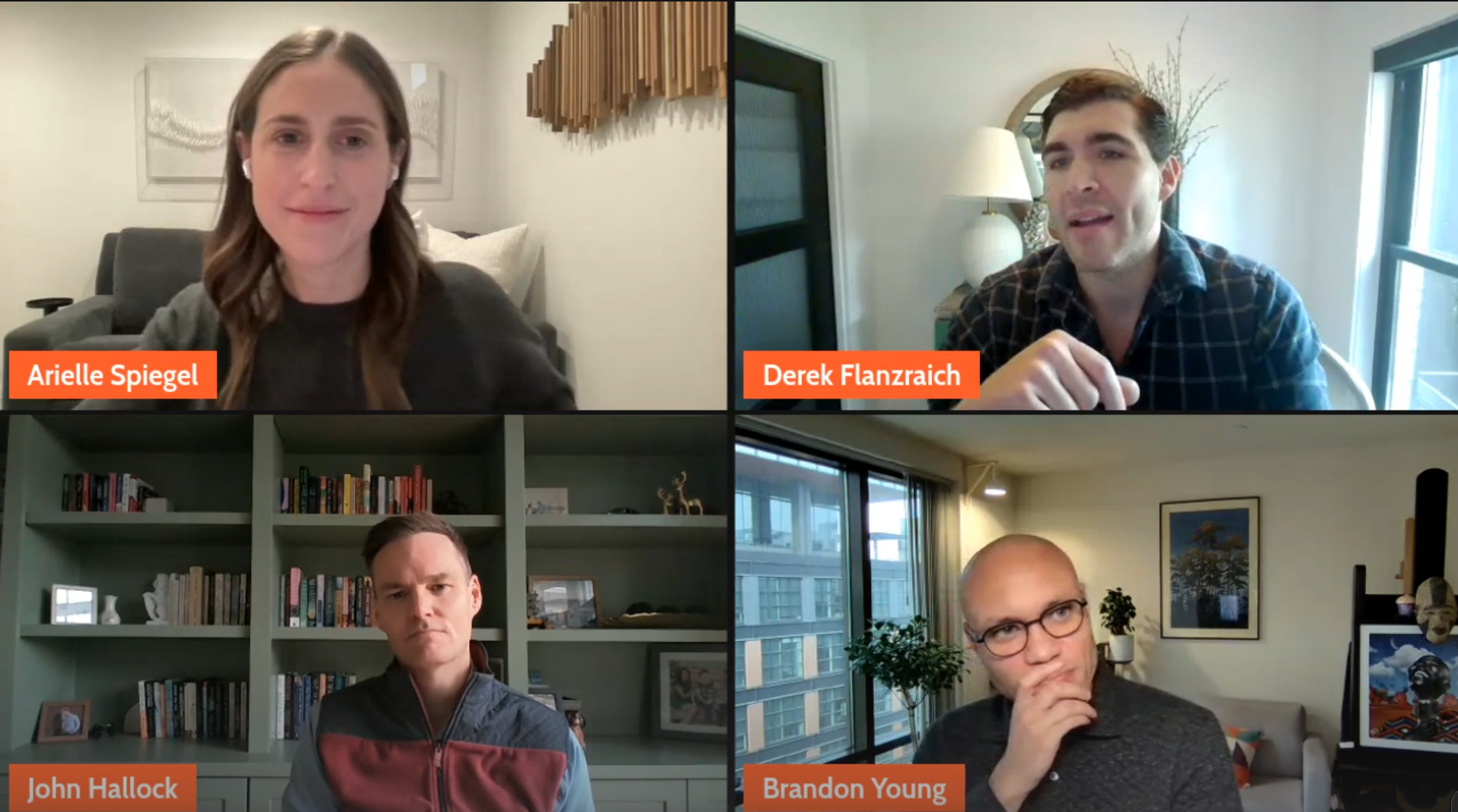
Our recent panel, “Supercharging Healthtech Marketing: Three Veteran Marketers Share Strategies in an Era of AI,” brought together industry leaders to discuss practical strategies for navigating healthtech marketing in an AI-driven world. Moderated by Derek Flanzraich, Founder and Managing Partner of Healthyish Ventures, the discussion featured three expert panelists:
- John Hallock, Chief Marketing & Communications Officer, Smarter Technologies
- Arielle Spiegel, Co-founder and veteran CMO, Cofertility
- Brandon Young, CMO, Garner Health
Our team of panelists shared insights on practical, real-world strategies for navigating shrinking budgets, rising CAC, and a crowded content landscape.
1. AI is a force multiplier, not a starting point
Starts at 10:19
Our session kicked off with a discussion on emerging trends in AI-driven content creation and the direction health companies are heading. Panelists emphasized that AI doesn’t replace core marketing fundamentals, but rather, it amplifies them.
As Hallock described it, AI and the various tools marketing teams are using act as a force multiplier. Any team member who is efficient in their role and comfortable leveraging these tools will become even faster and more effective. At the same time, AI needs a solid foundation of good content to work with. "If you're not capable of creating good content–engageable content without AI–I don't know how much AI is going to really help you," Hallock shared.
In a perfect world, Hallock sees PR and AI working together to really differentiate a company's story and cut through the jargon common in healthcare. At the same time, he explained that all the AI tools in the world aren’t going to do much for companies if they don’t have reporter contacts or analyst contacts or influencer contacts or the ability to create messaging.
Why this matters for healthtech marketers:
- AI accelerates strong marketing teams but does not compensate for weak fundamentals
- High-quality content is a prerequisite for effective AI use
- PR, relationships, and messaging remain critical inputs for AI-driven marketing
- Think of AI as layered amplification, not a replacement for core marketing skills
2. The traditional PR playbook no longer delivers results
Starts at 11:50
All three panelists agreed that PR remains an integral part of marketing strategy. Still, the mechanics of how it works have fundamentally changed. Instant third-party validation through traditional media is harder and less reliable than it once was. "Traditional media is dying; there are fewer healthtech reporters than there were five years ago," shared Young.
Hallock agreed, noting that the earned media landscape has changed, and that companies have either adapted to it or they haven’t. He added that the $20,000 or $30,000 monthly retainers that health companies typically provide to PR firms are no longer effective. Instead, strategy must come first, with spend following afterward. "You need to be really good at PR and have contacts and relationships, not just with reporters, but with influencers and industry and corporate marketers," Hallock added.
Key takeaways for healthtech marketers:
- PR strategies must adapt to a smaller, fragmented media landscape
- Relationships now extend beyond journalists to influencers and industry partners
- Strategy should drive PR spend, not traditional retainer models
- Earned media is most effective when activated across owned and paid channels
3. Strategy should guide budget allocation decisions
Building on the discussion about integrated channels, Arielle Spiegel suggested that budgets and team headcount be structured by strategy, rather than separating them strictly into owned, earned, or paid media. "You have to look at the landscape in a more integrated way and think through how you're organizing your team," she said.
Rather than allocating a fixed amount, such as $50,000 for PR or a specific campaign, Spiegel recommends evaluating the right mix of tactics based on audience, intent, or goals. This mindset shift prioritizes strategy over rigid channel-based budgeting, which can 10x the results of any campaign.
How this translates to healthtech marketing:
- Budget allocations should follow outcomes, not predefined channels
- Teams should be structured around strategy and goals, allowing flexibility across channels
- Audience, intent, and objectives should determine the marketing mix
- Integrated teams can adapt quickly to changing market dynamics
4. SearchGPT is reshaping how health companies get discovered
Young highlighted that SearchGPT is evolving rapidly, with user-generated content (UGC) playing a central role in how companies are discovered. Platforms like Reddit are increasingly surfacing in results, creating both opportunities and challenges for health companies. "If you're looking for reviews on your solution, the unpredictability of it builds a second challenge. You need to cover a lot more surface in the market than before to make sure you are in the top three results," Young explained.
Derek Flanzraich added that engaging authentically on community-driven platforms like Reddit is essential, since gaming them is extremely difficult.
Key takeaways for AI-driven discovery:
- User-generated content is becoming a core component of SearchGPT results.
- Brands must appear across multiple channels to maintain visibility.
- Community platforms like Reddit carry significant influence in AI-powered search.
A reminder on upcoming webinars:
Webinar Topic | Timing | Registration |
|---|---|---|
Unpacking the Data on the Telehealth Visits Patients Flocked to This Year | Jan 28, 2026 12 PM ET / 3 PM PT | Anyone can sign up here |
Breaking Point: How Soaring Healthcare Costs are Reshaping Employer Strategies | Feb 9, 2026 11 AM ET / 2 PM PT | Subscribers can sign up here |
Second Opinion x TytoCare: Unpacking CMS' $50B Investment into Rural Healthcare | Feb 5, 2026 12 PM ET / 3 PM PT | Anyone can sign up here |
5. Reviews now influence visibility across AI-powered search
Beyond Reddit, review sites such as G2 and TrustRadius are seeing a resurgence in importance. As large language models (LLMs) increasingly scan these platforms, reviews have become a critical input for AI-driven search. Health companies that monitor what customers, patients, and partners are saying gain a competitive advantage.
Young emphasized that this shift changes how performance marketing teams can operate. "Where before everyone had gamed the reviews, now LLMs are actually sifting through them. It went from just focusing on how many five-star reviews you could get to what I think is an opportunity for performance marketing," he noted. He added that performance marketing teams can act more like a PR channel, optimizing reviews for the right keywords and themes to boost discoverability.
Impact of reviews on AI-powered search:
- Review sites like G2 and TrustRadius are resurging as influential sources.
- LLMs scan reviews at scale, making them meaningful inputs for AI search.
- Language, keywords, and themes in reviews matter more than star ratings alone.
- Performance marketing teams can leverage reviews strategically to optimize visibility.
- Consistent and relevant review content signals credibility to AI models and increases visibility.
6. Cleaning up existing content delivers immediate gains
Derek Flanzraich emphasized that one of the simplest ways health companies can improve SearchGPT results is by optimizing the content they already have, rather than focusing solely on creating new content. He explained, "An interesting thing about ChatGPT is that it doesn't have a great sense of when you did something, and we're finding, even just on the content side at Parsely, that going through and cleaning up existing content really helps."
He noted cleaning up their company’s content had an immediate impact on their team’s LLMs as well as on SearchGPT, Google, and people visiting the company website. Content optimization takes many forms, but a few examples include: ensuring language is consistent across pages, fixing landing pages that are improperly formatted, updating outbound links, and removing or improving thin content. "People go to a lot more pages than they're thinking, and definitely LLMs are going to all the pages… It's really about putting your best foot forward," Flanzraich added.
Quick content optimizations for AI search:
- Remembering SearchGPT considers all content, both old and new
- Updating and standardizing existing content can create immediate performance gains
- Optimizing content provides a competitive advantage in AI-powered search
7. Paid social needs a fundamental rethink
Another trend Spiegel expects to see more healthcare companies adopt in 2026 is rethinking their paid social approach. She emphasized the importance of evaluating what paid social investments are truly delivering, rather than focusing on the size of the budget. "We have these vanity metrics that paid social is giving all of us, and some of them are really meaningless," Spiegel explained.
She highlighted Avia, a Gen Z–focused hormone-tracking app, which paused paid social marketing and redirected its budget toward content partnerships and organic marketing efforts. At the time, some saw the decision as risky, but it ultimately allowed the team to make their dollars work harder. Spiegel encouraged other companies to experiment creatively and examine how they’re spending on paid social, rather than defaulting to established ad channels.
Actionable insights for healthtech marketers:
- Paid social performance metrics don’t always reflect real business outcomes
- Rising ad costs make evaluating ROI increasingly critical
- Organic content and partnership channels can outperform paid campaigns
- Regularly reviewing and reallocating budgets can improve efficiency and impact
- Pausing or testing channels creatively can unlock growth opportunities
8. AI is changing what marketing leaders are valued for
Closing out the discussion, Young addresses how AI is fundamentally changing what's valuable in marketing and leadership roles. From his perspective, AI is forcing teams and leaders to rethink specialization, because narrow expertise is becoming less valuable. "AI is quickly becoming a better expert in healthcare and healthcare tech than we are. It will catch every little last nuance that we might have missed, and it's going to get better and better and better," Young explained.
So, where does this leave humans? According to Young, humans can still be the best generalists, responsible for stitching together context, judgment, and strategy across systems. Teams will still need generalists to manage AI systems, much like a strong manager leads a team. "Give AI a context, and the prompting it needs to come up with the best answer, but treat it as an expert," Young added.
Takeaways for marketing leaders:
- AI outperforms humans in narrow, specialized expertise.
- Human generalists remain essential for context, judgment, and strategic synthesis.
- Leaders must guide AI systems effectively, leveraging human strategic thinking as a competitive advantage.
In summary:
As AI continues to reshape healthtech marketing, our panel emphasized that having a strong foundation of content, PR, and strategy is an essential starting point for achieving meaningful results. Those who embrace AI as a force multiplier, experiment with new AI tools, and stay up to date with emerging trends will be best positioned for success. Leadership is evolving as well: generalists rather than specialists, who can work alongside AI and provide critical context and judgment, will be in higher demand than ever.
Tools highlighted during this panel:
- Canva: a content creation and design tool that helps teams quickly create visuals for marketing and social content.
- Nano Banana: an AI-powered image generation tool from Gemini that helps produce custom images for campaigns and content.
- Profound: an AI measurement tool used to track and evaluate the effectiveness of content and campaigns.
- Scrunch: another AI measurement tool ideal for tracking influencer or partner performance metrics.
- AirOps: a content engineering platform that streamlines campaign execution and content operations.
Want to support Second Opinion?
- 🌟 Leave a review for the Second Opinion Podcast
- 📧 Share this email with other friends in the healthcare space!
- 💵 Become a paid subscriber!
- 📢 Become a sponsor
About the author