

“Mom’s New Plus-One: An AI Pet?”Why this growth investor is bullish on robots for seniors in the home.
Meghan FitzGerald is a geriatric nurse practitioner, healthcare investor, and healthcare policy professor who studies and invests in the future of aging and care delivery.
By now, you’ve probably seen the news that Washington State is the first in the nation to authorize a statewide reimbursement code for a companion AI robot. This is a significant moment—an opportunity I’ve envisioned for years now taking shape.
I wear a few hats in my professional life. I’m an investor, former executive and board member, and a licensed acute geriatric nurse practitioner. At age sixteen, I was a live-in caregiver for my grandmother, Oma, who had Alzheimer’s—an experience that profoundly shaped my clinical path and interests in senior care.
We are at the precipice of something very big, and we’re not paying enough attention. I’ve been on a three-year journey examining how robotics and AI are colliding with the growing tsunami of chronic disease in an aging population.
Seniors benefit from interaction, touch, and comfort - especially in moments of need or when alone. Sometimes it’s a hand. Sometimes it’s a familiar object. Soon, I believe it may be a fluffy robot.
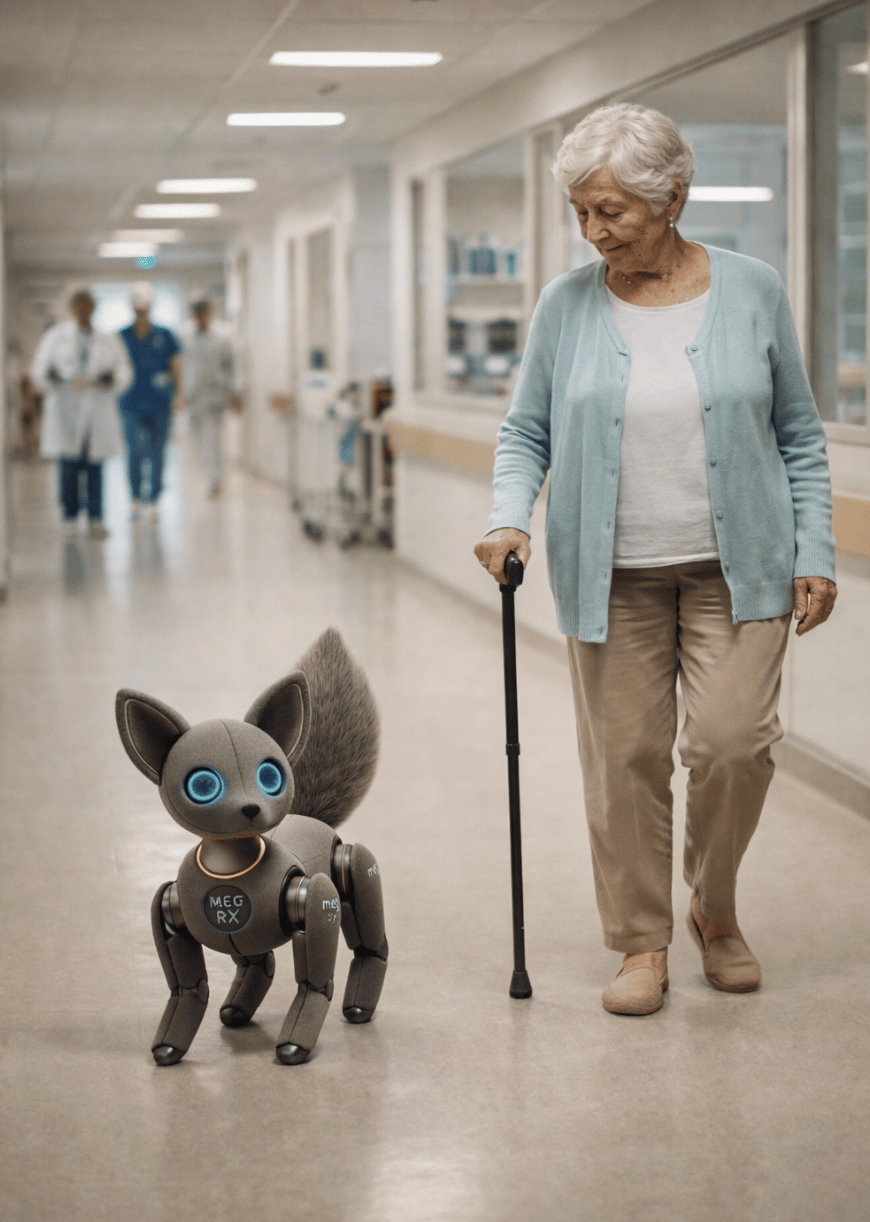
The US healthcare system is gliding into a clinical world where intelligence is ambient—and soon, embodied. Not as cold machines, but as adjunct companions: a voice, a presence, perhaps something that looks and behaves like a pet. But a functional pet that can provide a variety of different utilities, such as emergency alerts and medication reminders.
Throughout my career working in long-term care settings, providers have relied on simple tools to help manage loneliness and cognitive decline—games, toys, tactile objects, even the occasional ugly doll—anything seniors can touch, hold, and engage with. However, the technological solution for seniors will look less like a scary Terminator or fussy C-3PO and more symbolic to Wilson, Tom Hanks’s trusted volleyball companion in Cast Away.
The need is enormous. Aside from cognitive challenges, loneliness is a baseline experience for a third of aging adults, resulting in three times the rate of higher death and a 68% higher hospitalization risk. As caregiver shortages deepen and more seniors spend their final decade alone, AI-powered companion pets may become a simple but powerful presence—sitting beside them, listening, remembering, and offering emotional support.
Why not real pets?
As a serial dog owner and lover first, I understand—and deeply empathize with—the question. Data shows older adults benefit meaningfully from social interactions with pets, seeing lower rates of loneliness and improved well-being. The desire for constant companionship persists, yet the reality is that as one enters their oldest years, many can no longer own live pets due to concerns about outliving them, as well as cost, ADL limitations, or housing restrictions.
Companion robotic pets and AI are emerging as a high-value proposition. While their role in healthcare navigation is still evolving, the evidence is clear. They meaningfully improve how seniors experience care. Data show that robotic pets can reduce loneliness and depression, with measurable benefits in dementia care, including improved mood and reduced agitation.
Right now, AI-enabled tools are proving effective in continuous health monitoring including fall detection, medication adherence, and appointment coordination. Early research suggests this path maps to what seniors value: 89% desire appointment reminders, 79% emergency assistance, and 75% want ongoing health monitoring.
What’s the value prop for investors?
The opportunity in AI companion robotics isn’t just technological—it’s owning a demographic channel at the point of care. The 80+ population is the fastest-growing segment in the developed world, and their subsequent chronic disease challenges are rarely a single event—it is a continuous, resource-intensive state. Managing it requires coordination across fragmented systems, persistent monitoring, and a level of logistical support that families and providers alone cannot sustainably deliver.
The winner won’t be the smartest robot, but the one that earns a place beside the patient and becomes the operating system for care in the home. Much like the iPhone evolved from a communication device into a platform, these companions have the potential to layer in monitoring, coordination, and connection over time.
Investors are pouring tens of billions of dollars into robotics broadly—over $20 billion in venture capital in 2025 alone—with consumer and home robotics emerging as a fast-growing ~$14 billion market expected to expand rapidly as capable home robots and companions reach scale. Today the elder care robotic market is around $3b with estimates to triple by 2030.
Five years ago, most had never heard of OpenAI or Anthropic. This month, every investor was focused on getting in their latest $25B round and these companies are arguably propping up the stock market (alongside Nvidia) The adoption and launch of new technologies is already unfolding rapidly, particularly globally.
This AI market frenzy and senior care curiosity sent me on a journey speaking with experts in the US and Asia. During my journey, I mocked up the ideal senior companion, a fox that looked like my Weimaraner pup (he goes by Claus) with functionality for a senior living alone. This owner-named pet device would combine comfort and basic benefits—soft, tactile design with night lighting, warming/cooling features, Bluetooth for music or games, fall alerts, and a caregiver or 911 button.
Ultimately, my work led me to invest in and join the board of Ageless Innovation, a leader in robotic companion pets for older adults—including a small robotic bird that sits on a patient’s walker and squawks as a fall-prevention cue. I believe the field is wide open for innovation and channel development partners because the unmet need is so high.
It’s my view that adoption will depend less on clinical capability and more on emotional resonance and ease of use. The successful companion will focus on a narrow set of reliable functions, with risks including privacy and ethics as table stakes. Data only matters if it is actionable and integrated into care as part of a broader ecosystem of technologies serving the same patient.
Ultimately, entry pricing, regulation, security, and reimbursement will determine how quickly this technology can scale. Another positive for investors, the regulatory landscape is evolving, as seen in remote patient monitoring, which has gained support from CMS and is helping to accelerate adoption.
Companion pets will likely play an important role in this journey, with the added advantage of being physically closest to the patient—a powerful moat. We are going from bedside to bedside. To be clear, robots will never replace clinicians or human caregivers. Their role is to facilitate care, not deliver it.
The greatest value for companion robotic pets may simply be their presence: a “live-in” companion filling the critical gaps between care shifts for patients living alone.
About Meghan Fitzgerald

Meg is a global healthcare strategist, investor, academic, and author. She has worked in every domain of healthcare from front-line patient care through the Fortune 500 while serving as an Adjunct Professor at Columbia University. Currently, Meg is a private equity investor where she serves as a senior advisor to several firms, including Goldman Sachs.
Before this, Meg spent twenty years in Corporate America working for many prominent healthcare companies. She was the EVP of Strategy, M&A and Health Policy at Cardinal Health (CAH) and a member of the executive committee. Before she was the President of Cardinal Health Specialty Solutions, one of the fastest growing businesses, where her team took an underperforming division from $700mm USD to over $8BUSD in four years. Meg was the SVP of New Markets and Business Development at Medco Health Solutions (MHS). She previously held positions in strategy and marketing at top companies, including Pfizer, Merck, and Sanofi-Synthelabo.
Currently, Meg is a member of the board of directors at Tenet Healthcare (THC), a leading Fortune 200 healthcare services company, where she chairs the NCG committee and is a member of the quality and safety committee. She is a
founder of K2HealthVentures, a life science investment fund ($1B AUM). She is also the founder of Grey Ghost Capital (50mm AUM), making equity investments into cyber security (Circle-AI), blockchain (Chronicled), and mental health
(Mindbloom).
Meg obtained a Doctor of Public Health (DrPH) at New York Medical College, focusing on health policy and the social determinants of health. She earned a Master of Public Health from Columbia University and a Bachelor of Nursing from Fairfield University. During the pandemic, Meg went back to school and attained a master of Science in Nursing as an acute geriatric nurse practitioner. Currently, Meg teaches strategy and “The Business of Healthcare” at Columbia University in New York. Her book “Ascending Davos: A career journey from the emergency room to the board room” was launched in 2020.
Meg is a lifelong runner, extreme sports enthusiast, and mixed martial arts fan. She resides in Naples, Florida, and Martha’s Vineyard with her husband and rescue Weimaraner.
Want to support Second Opinion?
- 🌟 Leave a review for the Second Opinion Podcast
- 📧 Share this email with other friends in the healthcare space!
- 💵 Become a paid subscriber!
- 📢 Become a sponsor
About the author