

This founder shares his playbook for early-stage growth hacking that works
Why disciplined testing may be your strongest edge in consumer health
Building a consumer health company has never been easier. Labs, eligibility checks, telehealth, revenue cycle management, medications, and medical records are now an API away. That’s great for builders, but it also means the real competitive battleground has shifted.
Today, distribution and customer acquisition are where consumer health companies win or lose.
Two schools of thought on growth
Most growth advice falls into one of two camps:
- Take big swings: Bet on 3–5 home runs a year and hope one hits big:a marquee partnership, a celebrity physician, a viral campaign.
- Run 1,000 experiments: Ship constant small tests, improve conversion or CAC by 1-5% at a time, and let compounding do the work.
Big swings can be transformative. Think Prenuvo and Kim Kardashian, Function Health with Mark Hyman, or Oura’s NBA deal. But these wins are notable precisely because they are rare.
In practice, most value in consumer health is created through slow, unsexy compounding. But the high-velocity experimentation playbook has historically been out of reach for early-stage companies. Until now.
Over the past 18 months, we’ve reduced our CAC 3-5X by running hundreds of experiments with less than one full-time growth hire. Increasingly, other seed- and pre-seed-stage consumer health companies are doing the same.
Why growth experimentation is now viable earlier than ever
The goal of growth experimentation is simple: build a scalable acquisition funnel that produces healthy customer acquisition costs relative to expected lifetime value.
We are adamant about using the word experimentation internally because language shapes culture. It reinforces a scientific mindset (assumptions, hypotheses, measurement, decision rules) and normalizes being wrong.
This approach used to require deep pockets. Companies like Noom can afford 15-20 “growth product managers”, but most of us don’t have that luxury.
Two structural shifts have changed that:
1. Building got fast
Landing pages, quizzes, drip campaigns, and ad variants can now be built in hours or even minutes, often without engineering support. Early-stage teams benefit even more because they have less legacy complexity.
2. Measurement got easy
Modern analytics, CRMs, and website builders increasingly include built-in experimentation and attribution capabilities.
A few years ago, high-velocity testing required a growth PM, multiple engineers, a designer, and a data scientist. Today, early-stage teams can approximate the same loop with a founder + Devin, an engineer + Claude code, or a marketer + Lovable.
To be clear, experimentation is useless (or even dangerous) without a compelling offering that actually improves health outcomes and sustainable unit economics. Great marketing can't fix a bad product. And you do need enough traffic to reach statistical significance in a reasonable timeframe.
But if you clear those hurdles, building a differentiated growth engine using experimentation can be critical in an industry where gross margins don't support lavish customer acquisition costs.
A reminder on upcoming webinars:
Hospitals as the new go-to-market, lessons from the trenches | Mar 3, 2026 12 PM ET | Anyone can sign up here |
Where experimentation actually works in consumer health
So let’s start with a simple question. What are we experimenting on?
To keep the scope manageable, we focus experimentation on conversion-driving funnel steps. This applies equally to DTC and B2B2C health companies, which in practice often operate like direct-to-consumer models with subsidized pricing.
After spending months thinking about this obsessively, here's how we map the terrain:
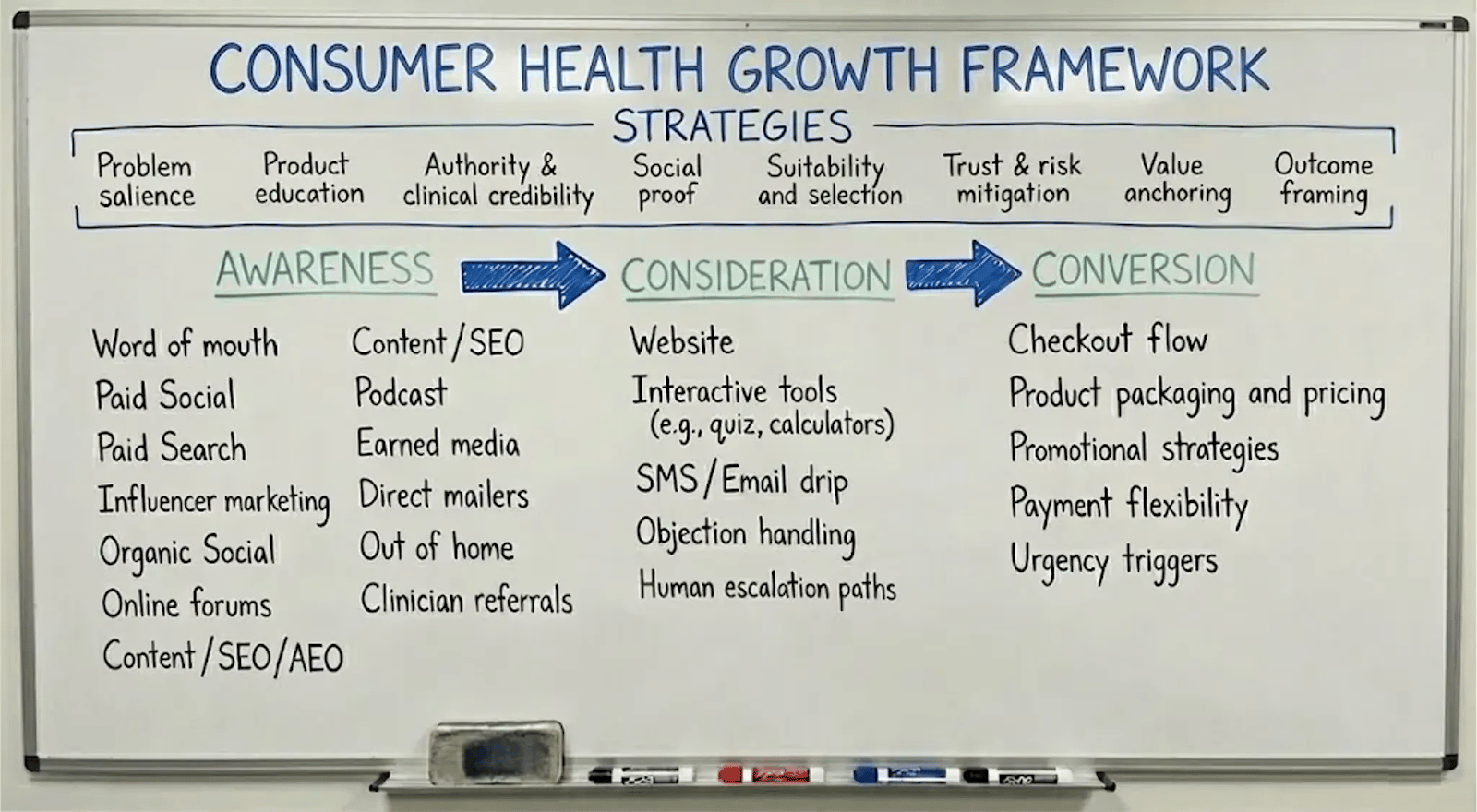
Each item offers a significant surface area for experimentation. However, many teams over-index on the edges:
- Awareness: testing dozens of UGC hooks
- Checkout: adding trust badges or eligibility callouts
The middle consideration phase is often under-explored, and in healthcare, it is frequently the highest-leverage surface area. That’s because healthcare is rarely an impulse purchase. Clients need reassurance, clinical credibility, and clarity about whether the product is right for them.
So let’s talk about what has specifically worked for us within this underutilized middle bucket and why.
Why quiz funnels work so well in consumer health
Quiz funnels are worth calling out specifically as they're one of the few tactics that can credibly support every strategy across the framework. That’s why they anchor acquisition strategies at category leaders like Hims, Ro, and Noom.
A well-designed quiz functions as:
- A digital salesperson, handling objections and explaining value
- A digital triage nurse, filtering for appropriate clients
After hundreds of quiz iterations, a few patterns consistently emerge for us:
- Length often improves performance (counterintuitively) in part due to sunk-cost psychology
- Every question must have a clear, intuitive purpose
- It’s hard to overdo credibility signals in healthcare
- Don't waste the opportunity to filter out clients you can't serve well
The consumer health experimentation loop
1. Ideate
The problem typically isn't finding enough ideas to test; it’s prioritizing them. A system can help, including a weekly meeting cadence and basic prioritization templates, and should be minimalistic to reduce friction.
But there is no shortcut to developing the intuition on what will work other than repeated customer exposure. For me, this meant running 75 coaching sessions and taking hundreds of sales and customer service calls. Patterns start to emerge quite quickly (objections, confusion, language that resonates) and are often the best source of ideas.
Beyond direct exposure, there have been several helpful sources of growth ideas:
- Thought leaders: There are people who literally write down growth ideas for a living (we love growth, design, and marketingideas.com, there are many others)
- AI: Simply feeding your context (website, ads, video of signup flow, documents) to a reasoning model typically yields decent results.
- Analogs: Deep Research, ad libraries, and signing up yourself to understand what other players in the space are doing (and wthe ayback machine to see what didn’t work).
While analogs are a great source of ideas, they are also the most dangerous. You can be copying something that doesn’t work for them, or will not work in the context of your product, target market, and business model.
2. Deploy
Given the importance of speed of learning as a startup, we’ve prioritized ideas that can be implemented in minutes or hours, and reserve longer builds for high conviction bets. Having a cracked engineering team certainly makes this easier, but consider when no-code tools might make experimentation easier (e.g., Typeform/Jotform to quickly iterate on a quiz funnel, Lovable/Replit to spin up landing page variants).
Importantly, writing down a hypothesis on what will happen is an important way to audit your judgment and build your intuition over time.
The major caveat with deploying quickly is the moral and legal constraints we work with in healthcare. "Move fast and break things" worked for Facebook but "breaking things" in healthcare can mean an FTC violation, HIPAA breach, or making promises to clients you can’t keep. This tension can be addressed with systems such as a repository of pre-approved copy.
3. Measure
Growth experimentation does not work without a robust measurement apparatus, including source attribution and funnel analytics. Investing the time upfront to set up automated measurement (and paying the outrageous fees for HIPAA tiers) will save time and sanity. Even as a former actuary, running proper statistical significance tests can be tricky and time-consuming. Just let the software do the math.
However, the math alone can sometimes be misleading - it's easy to miss signals or red herrings if no one is paying very close attention. A new ad creative might be ripping, but bringing the wrong type of client. A new quiz funnel update may show a massive increase in conversion, but it’s being measured incorrectly. There is a certain level of obsession required to do this well: checking analytics daily, watching session replays, thinking through failure modes.
It is also quite fun. Tools like PostHog include “Bayesian” mode, where you can see the “Win probability” for an experiment at any time. If you’ve ever checked betting odds during a sports game, or pulled up Polymarket to track a real world event, it’s a similar thrill.

Screenshot: A satisfying result from an experiment on PostHog — large effect size with high certainty
The primary warning here is to not be a “spreadsheet marketer”. Numbers are fun, but it’s easy to fall into the trap of optimizing CAC and losing sight of the overall client experience, particularly in the healthcare context. A 5% improvement in conversion rate is not worthwhile if it creates a negative emotional state or recruits the wrong type of client.
4. Document
This step is easy to skip (we’ve been guilty), but it is important for building organizational intuition over time. Documenting “wins” in particular can be a great source of new growth ideas.
For example, if one type of messaging worked in a drip campaign, where else can that language be embedded? Or if HSA/FSA/insurance “use it or lose it” language in December works, how else can you create a sense of urgency?
Documenting losses is useful too, but typically for a different reason. Six months later, if someone proposes something already tested, you'll avoid a wasted cycle. Here are a few examples of our failed experiments:
- Partnerships with major influencers. We’ve seen up to a ~100X difference in conversion rate across influencers, and larger has certainly not always been better.
- Deep discounting (e.g., 50% off). The “cheapening” effect was likely more powerful than the price sensitivity, which is likely often true in consumer health.
- Spending half a Saturday biking around NYC, dropping off flyers for a new product launch (exactly one signup!)
Just start
With AI and measurement tools, you're probably not too early-stage to benefit from experimentation.
If you haven't started, try something simple: A/B test your hero headline. Almost every company has enough traffic to get a signal on CTA clicks, and seeing a 5-10% lift from a copy change is often enough to catch the bug.
In an industry where margins are tight and trust is everything, disciplined growth experimentation may be one of the few competitive advantages still available.
Not already a Second Opinion subscriber?Get weekly insights on health‑tech delivered straight to your inbox. Join the mailing list for free Or copy & paste this link into your browser: |
About the author